


How to choose a Print and Apply applicator
Print and apply is a labeling system made up of a label printer, label handling unit, and a label applicator. It enables manufacturers to create and place labels directly onto products and product packaging. Label types can vary widely and can include barcodes, product information, tractability data, branding, and serialization.
Print and apply offers a range of application methods to suit the wide variety of production methods and products. It is essential to understand their benefits and limitations to make sure you choose the one which meets your specific requirements.
Below, we’ve compiled a guide to help you choose the most common application method that is right for your business.
Blow applicator
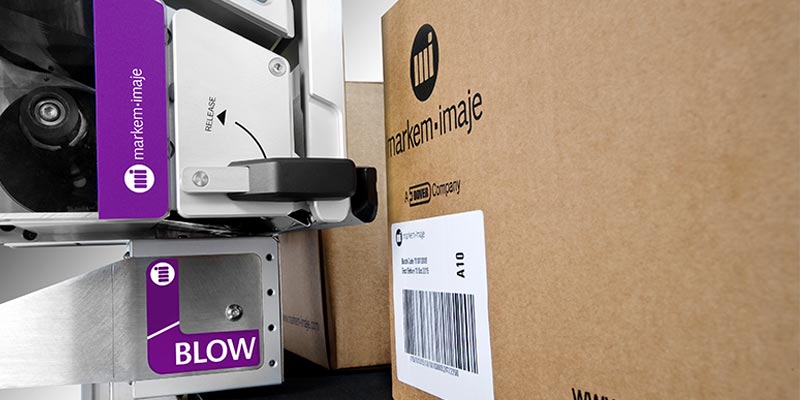
A Blow applicator works by feeding the label from the printer onto a vacuum grid and blowing it across the void onto the product with a jet of air.
Benefits
Blow applicators are non-contact and due to no moving parts, can be extremely fast, making it ideal for any industry with higher speed lines or products that have undulating surfaces such as soft-drinks or health-care products. Being contact-free, there is no potential for snagging on packaging such as shrink wrap. The design requires minimum maintenance.
Limitations
Because the Blow applicator uses air to blow labels across the void, it can consume a lot of air. If a Blow applicator isn’t set up properly, label positioning accuracy can be challenging, and they are not best suited for larger label formats. It can also be limited in ‘throw’ distance as further distances result in poor label adhesion and placement accuracy. Label quality can play a big part in the overall performance.
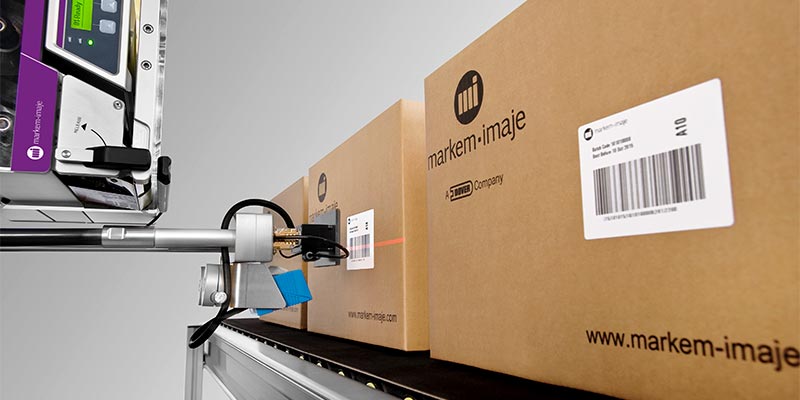
Tamp-Blow applicator
Tamp-Blow are generally the same technology as Tamp, where an electrical or air-driven linear actuator is used to advance the label and directly contact the product.
The only difference between them is that with Tamp-Blow, the applicator moves out to get as close as possible to the product, without making contact, and blows the label using air onto the product surface.
Benefits
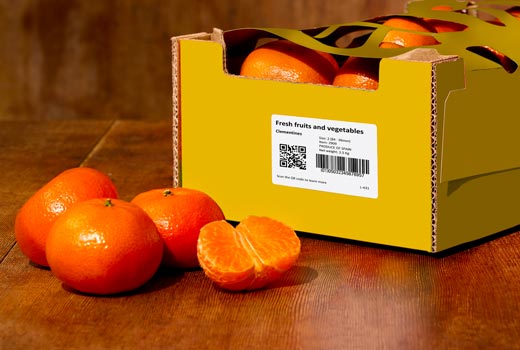
Like pure Blow, Tamp-Blow can stick labels on to undulating surfaces but as the label is moved closer to the product it can overcome the demand for larger apply distances. Tamp-Blow is also good for labelling onto low sided trays where the tray/product may be a distance from the applicator and close to the conveyor belt. Such applications still require label compliance and therefore require smaller wide format labels to easily accommodate the tray shape whilst maintaining the need for all of the necessary data which would typically include GS1 barcodes and other product data for full traceability.
Limitations
A key disadvantage of Tamp-Blow is that application distance can limit speeds. Although the fact that part of the application cycle is replaced with a fast blow which enables them to be faster than a standard Tamp in the same application, it can be challenging to achieve enough air force to make labels adhere effectively to some surfaces.
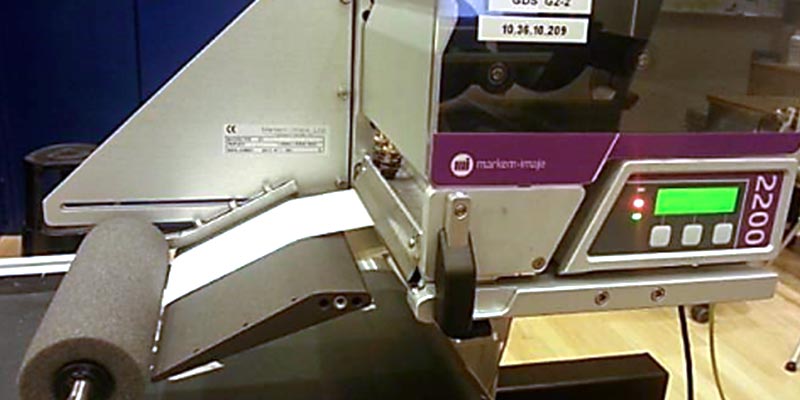
Synchronous Feed applicator
As the name suggests, a Synchronous Feed applicator is synchronized to the speed of the product or the conveyor.
Benefits
Because this applicator enables the label to be fed onto the product as it is being peeled from the printer, it is generally considered a simple application method. It only allows the placement of labels in the direction of movement, so is suited to labeling the top or the side of product packaging. It can accommodate a wide range of label sizes and generally needs little adjustment for label size changes.
Limitations
A key disadvantage is that, with products that are required to be in the center of the conveyor or away from the edge of the conveyor, Synchronous Feed is unable to reach them easily. This requires additional product handling, to move the product to the conveyor edge, or a long ‘beak’ extension to reach the products, which introduces a label buffer and risk of labelling errors - especially at production change-over. For manufacturers that run higher speed lines further product handling is required to ensure the product speed is reduced to ensure good label adhesion and to prevent missing labels or label wrinkle. In most cases Synchronous Feed forces the label data to be printed along the label (narrow edge leading), this can cause degradation of print quality and increased printhead wear. This increases the risk of barcode read failures and adds to maintenance costs.
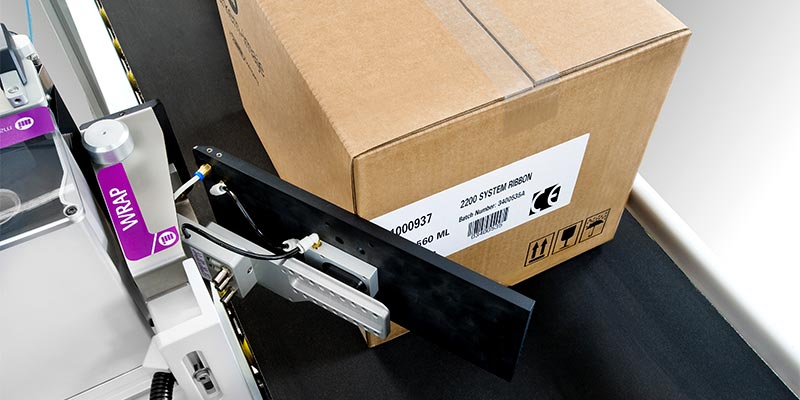
Wipe applicator
The Wipe applicator works by taking the label and then feeding it onto a rotating arm. It is suited for a multitude of applications from single side apply to multiple surfaces, including front or rear-end surfaces, or a combination.
Benefits
Because it supports a range of labeling options, flexibility is Wipe’s key advantage. It provides the ability to reach places inaccessible to other applicators, allowing access to the front, rear and side, and even in some cases corner wrap. It can also be easily changed to meet new labeling requirements or changes in production demands.
The Wipe is beneficial for shrink-wrapped products which require a label at the front, or where the manufacturer doesn’t have the ability to rotate the product, due to speed or product limitations such as decorative artwork.
Limitations
While being air-driven and mechanical makes the Wipe applicator highly suitable for lower speed applications, in many cases its flexibility doesn’t extend to allow for multiple labels sizes without mechanical intervention. Higher speed options tend to be limited in their flexibility, but allow you to avoid expensive production line changes which are typically required to rotate products at speed.
How Markem-Imaje can help
Print and apply continues to have a valuable place in manufacturing but making the best choice of applicator requires the careful consideration of packaging and facility needs.At Markem-Imaje, we provide a wide range of applicators for a range of sizes, products and packaging types, minimizing the need for line changes and expensive modifications. Our print and apply options have a proven track record of increasing uptime. We can advise on the best type of print and apply applicator to meet your requirements.